
A beautifully hand-drawn Watch, Quarter, Fire, and Station Bill for an American warship
“WATCH QUARTER FIRE AND STATION BILL.” American, after 1867, probably late 1860s-early 1870s.
Folio log book (17”h x 12”w), of which 84 pp completed in manuscript in several colors of ink including black, blue, red, and yellow, with gold and silver highlights, including a terrific hand-drawn and -colored title page. Recent 1/2 calf over pebbled plum cloth with title in gilt on a black morocco spine label. Contents generally excellent, with minor edge tears to a few leaves and separations at fold along first couple of leaves. Some water damage to boards and front endpapers. Pen-and-ink diagram of a ship’s deck, 7 ¾”h x 13 ½”w laid in, its relationship to the Bill, if any, is not known.
$4,500.00
In stock
A remarkable and unusually handsome manuscript record of the organization and daily operation of a post-Civil War American warship.
The Bill
A Watch, Quarter, Fire, and Station Bill was a shipboard roster assigning every member of a crew his duties and station for watchkeeping, routine operations, battles, and emergencies. In effect an organizational blueprint for the ship’s company, it specified where each man was to report and what he was to do under different circumstances—from standing watch and manning the guns to responding to fire and other emergencies.
This example is rendered entirely in manuscript and is remarkable for the quality of its execution. The title page is a finely rendered full-color composition, with a sailing warship underway at center, flanked by allegorical female figures bearing American flags and shield, and surmounted by the national arms, eagle and elaborate scrollwork. The following pages are executed with comparable precision, with intricate headings and rules in several colors, carefully differentiated lettering, and an unusually neat hand throughout.
The volume was never filled in for a particular ship’s company: Its organizational scheme appears complete—the duties, stations, procedures, divisions and allotted places for officers and crew are all present—but the names of the individual men who would have filled those places were never entered.
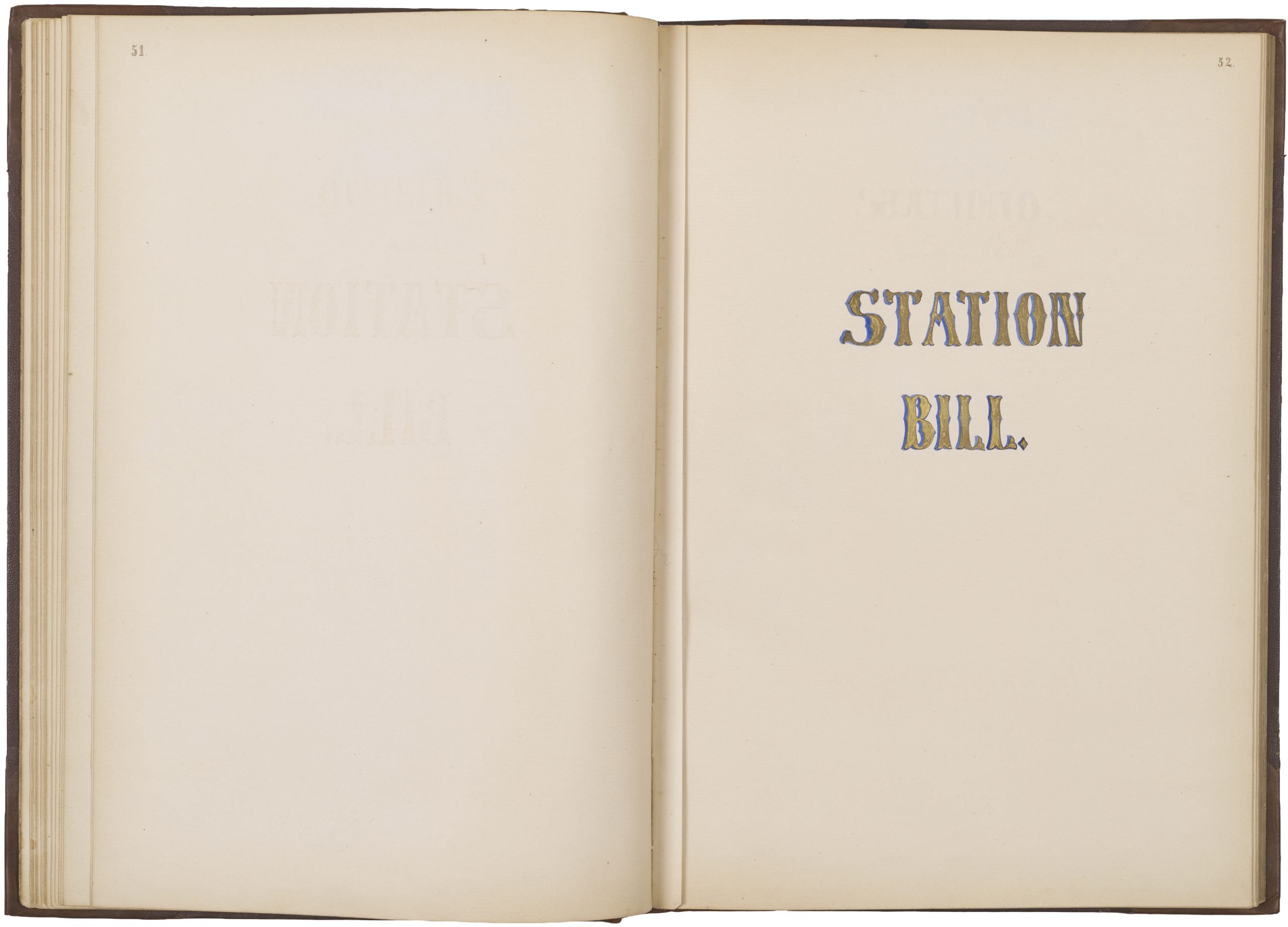
The contents are considerably broader than the title suggests. In order, the volume comprises seven sections headed “Watch Bill,” “Quarter Bill,” “Fire Bill,” “Boats-Crews,” “Station Bill,” “Routine,” and “Force Bill.” The Watch Bill divided the ship’s company into watches for the ordinary work of the vessel; the Quarter Bill assigned stations for battle; the Fire Bill provided for fighting fires; Boats-Crews assigned men to the ship’s boats; the Station Bill set out stations for working and handling the ship; Routine prescribed recurring shipboard duties; and the Force Bill provided for the distribution of men of different ratings among the several parts of the vessel.
The Bill is striking for the extraordinary detail it provides about the actual operation of an American naval vessel of the period. To give but one example, the “Fire Bill” (pictured) lays out the duties of officers, divisions and individual gun crews in the event of fire, specifying where men were to report, which pumps and hoses were to be manned, how ammunition was to be protected, and how different parts of the ship were to be cleared or secured.
Dating the Bill and identifying the vessel
The Bill was drawn in a commercially-produced blank record book bearing the label of the celebrated Rio de Janeiro firm of G. Leuzinger. The label advertises, among other enterprises, its “Fabrica de Livros de Escripturação”—manufactory of account and record books—making it likely that the volume was purchased from Leuzinger and subsequently put to use for an American naval vessel.
The label also helps date the volume. Its reference to a “Menção Honrosa na Exposição de Paris” points to the honorable mention received by Leuzinger at the Paris Universal Exposition of 1867, providing a terminus post quem of that year. Further, on November 1, 1872 Leuzinger admitted his three eldest sons into partnership and the firm thereafter became G. Leuzinger & Filhos. The use here of the earlier “G. Leuzinger” name thus suggests a date of roughly 1867-72, though older stocks of labels could of course have remained in use thereafter.
The Bill itself offers further clues to the vessel for which it was intended. Its allotted stations appear to provide for a complement of some 219 officers and men: roughly fifteen officers and other senior personnel, from the Commander and Lieutenant Commander down through the Carpenter and Sailmaker, together with places for 204 additional crew. Its battery comprised two 11-inch guns mounted fore and aft, four 9-inch guns, a 60-pounder rifle and a 20-pounder rifle. This combination points toward one of the medium-sized wooden screw sloops that formed an important part of the U.S. Navy’s cruising force during and after the Civil War—wooden-hulled, ocean-going warships combining a full sailing rig with a steam engine driving a screw propeller.
Among the closest comparisons are Wyoming, Kearsarge and Wachusett, closely related screw sloops of the generation immediately before and during the Civil War, though not all members of a single class. Their batteries were altered repeatedly, and each at one time or another carried combinations broadly comparable to that recorded here: by July 1871, for example, Wyoming mounted two 11-inch and four 9-inch smoothbores together with 20-pounder rifles, and earlier had carried a 60-pounder rifle. None, however, has yet yielded an exact match for both the present battery and its projected complement of roughly 219 officers and men.
Taken together, the manuscript’s elaborate execution, high level of detail, and clues to the identity of its vessel make it a rich survival from the post-Civil War U.S. Navy.
References
See Andrea C. T. Wanderly, “Cronologia de Georges Leuzinger (1813 – 1892)” at https://brasilianafotografica.bn.gov.br/ for a history of the firm of Leuzinger. For a discussion of American naval vessels and their armament, see Robert W. Neeser, “The Ships of the United States Navy, 1776-1915” in United States Naval Institute Proceedings, vol. 41 no. 158 (July-Aug., 1915), pp. 1185-1196 and ship histories on the web site of the U.S. Naval History and Heritage Command. All accessed August 2026.
Inventory ID:




A beautifully hand-drawn Watch, Quarter, Fire, and Station Bill for an American warship
“WATCH QUARTER FIRE AND STATION BILL.” American, after 1867, probably late 1860s-early 1870s.
$4,500.00
In stock
Folio log book (17”h x 12”w), of which 84 pp completed in manuscript in several colors of ink including black, blue, red, and yellow, with gold and silver highlights, including a terrific hand-drawn and -colored title page. Recent 1/2 calf over pebbled plum cloth with title in gilt on a black morocco spine label. Contents generally excellent, with minor edge tears to a few leaves and separations at fold along first couple of leaves. Some water damage to boards and front endpapers. Pen-and-ink diagram of a ship’s deck, 7 ¾”h x 13 ½”w laid in, its relationship to the Bill, if any, is not known.
A remarkable and unusually handsome manuscript record of the organization and daily operation of a post-Civil War American warship.
The Bill
A Watch, Quarter, Fire, and Station Bill was a shipboard roster assigning every member of a crew his duties and station for watchkeeping, routine operations, battles, and emergencies. In effect an organizational blueprint for the ship’s company, it specified where each man was to report and what he was to do under different circumstances—from standing watch and manning the guns to responding to fire and other emergencies.
This example is rendered entirely in manuscript and is remarkable for the quality of its execution. The title page is a finely rendered full-color composition, with a sailing warship underway at center, flanked by allegorical female figures bearing American flags and shield, and surmounted by the national arms, eagle and elaborate scrollwork. The following pages are executed with comparable precision, with intricate headings and rules in several colors, carefully differentiated lettering, and an unusually neat hand throughout.
The volume was never filled in for a particular ship’s company: Its organizational scheme appears complete—the duties, stations, procedures, divisions and allotted places for officers and crew are all present—but the names of the individual men who would have filled those places were never entered.
The contents are considerably broader than the title suggests. In order, the volume comprises seven sections headed “Watch Bill,” “Quarter Bill,” “Fire Bill,” “Boats-Crews,” “Station Bill,” “Routine,” and “Force Bill.” The Watch Bill divided the ship’s company into watches for the ordinary work of the vessel; the Quarter Bill assigned stations for battle; the Fire Bill provided for fighting fires; Boats-Crews assigned men to the ship’s boats; the Station Bill set out stations for working and handling the ship; Routine prescribed recurring shipboard duties; and the Force Bill provided for the distribution of men of different ratings among the several parts of the vessel.
The Bill is striking for the extraordinary detail it provides about the actual operation of an American naval vessel of the period. To give but one example, the “Fire Bill” (pictured) lays out the duties of officers, divisions and individual gun crews in the event of fire, specifying where men were to report, which pumps and hoses were to be manned, how ammunition was to be protected, and how different parts of the ship were to be cleared or secured.
Dating the Bill and identifying the vessel
The Bill was drawn in a commercially-produced blank record book bearing the label of the celebrated Rio de Janeiro firm of G. Leuzinger. The label advertises, among other enterprises, its “Fabrica de Livros de Escripturação”—manufactory of account and record books—making it likely that the volume was purchased from Leuzinger and subsequently put to use for an American naval vessel.
The label also helps date the volume. Its reference to a “Menção Honrosa na Exposição de Paris” points to the honorable mention received by Leuzinger at the Paris Universal Exposition of 1867, providing a terminus post quem of that year. Further, on November 1, 1872 Leuzinger admitted his three eldest sons into partnership and the firm thereafter became G. Leuzinger & Filhos. The use here of the earlier “G. Leuzinger” name thus suggests a date of roughly 1867-72, though older stocks of labels could of course have remained in use thereafter.
The Bill itself offers further clues to the vessel for which it was intended. Its allotted stations appear to provide for a complement of some 219 officers and men: roughly fifteen officers and other senior personnel, from the Commander and Lieutenant Commander down through the Carpenter and Sailmaker, together with places for 204 additional crew. Its battery comprised two 11-inch guns mounted fore and aft, four 9-inch guns, a 60-pounder rifle and a 20-pounder rifle. This combination points toward one of the medium-sized wooden screw sloops that formed an important part of the U.S. Navy’s cruising force during and after the Civil War—wooden-hulled, ocean-going warships combining a full sailing rig with a steam engine driving a screw propeller.
Among the closest comparisons are Wyoming, Kearsarge and Wachusett, closely related screw sloops of the generation immediately before and during the Civil War, though not all members of a single class. Their batteries were altered repeatedly, and each at one time or another carried combinations broadly comparable to that recorded here: by July 1871, for example, Wyoming mounted two 11-inch and four 9-inch smoothbores together with 20-pounder rifles, and earlier had carried a 60-pounder rifle. None, however, has yet yielded an exact match for both the present battery and its projected complement of roughly 219 officers and men.
Taken together, the manuscript’s elaborate execution, high level of detail, and clues to the identity of its vessel make it a rich survival from the post-Civil War U.S. Navy.
References
See Andrea C. T. Wanderly, “Cronologia de Georges Leuzinger (1813 – 1892)” at https://brasilianafotografica.bn.gov.br/ for a history of the firm of Leuzinger. For a discussion of American naval vessels and their armament, see Robert W. Neeser, “The Ships of the United States Navy, 1776-1915” in United States Naval Institute Proceedings, vol. 41 no. 158 (July-Aug., 1915), pp. 1185-1196 and ship histories on the web site of the U.S. Naval History and Heritage Command. All accessed August 2026.
Additional information
| year published | 1870 |
|---|


